

 admin
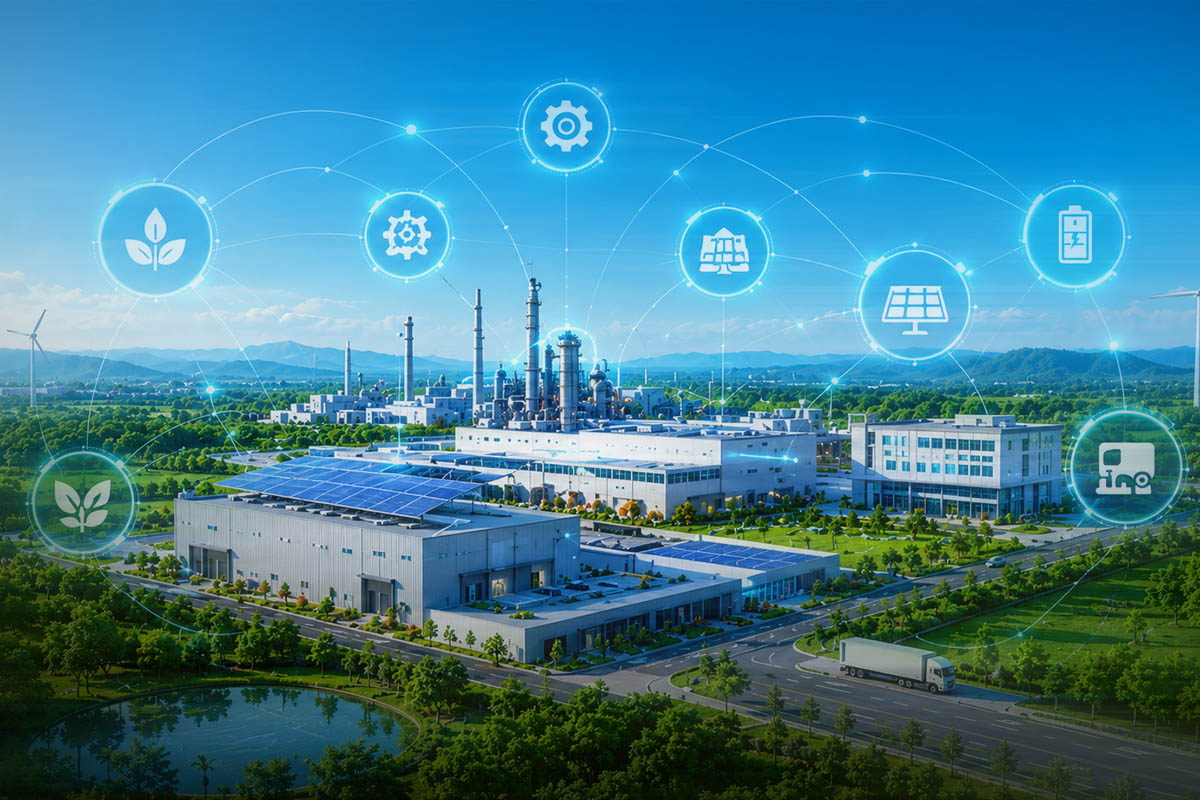
For decades, an industrial development was measured largely by one thing: how much factory space it could provide. A plot. A building. Roads. Utilities. And enough room to manufacture.
But the way businesses operate has changed.
Today, manufacturers and logistics companies need more than physical space. They need faster setup, reliable infrastructure, efficient logistics, digital connectivity, access to skilled talent, sustainability, and room to scale.
This shift is transforming the role of industrial parks.
Across India, industrial development is moving towards integrated ecosystems that bring together manufacturing, logistics, technology, workforce infrastructure, and supporting services. In fact, the Government of India has mapped 4,523 industrial parks across the country, covering around 7.70 lakh hectares, with approximately 1.35 lakh hectares currently available for industrial development.
The numbers point to a larger trend: industrial infrastructure in Gujarat and across India is no longer simply about creating space. It is about creating an environment in which businesses can operate efficiently and grow.
The right ecosystem can change how you grow.
From Factory Space to Business Ecosystem
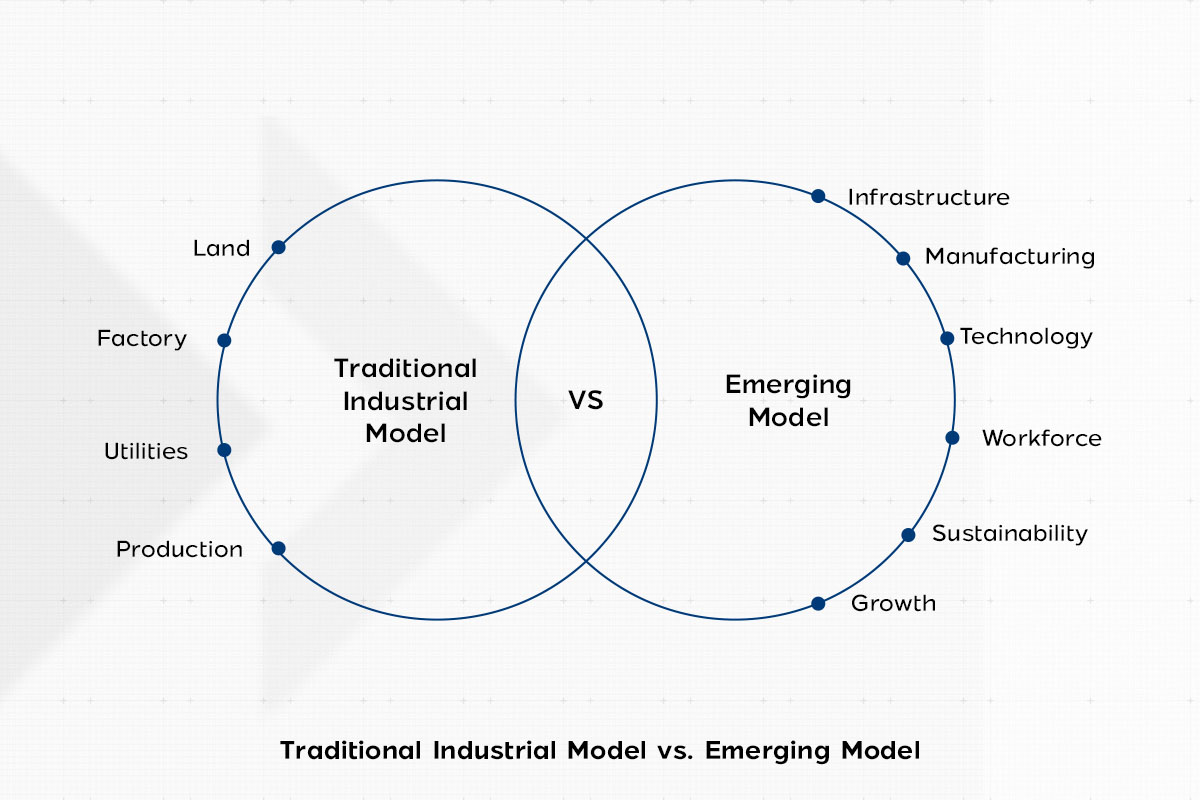
A factory doesn’t function independently. Raw materials must arrive, products must move, employees need access to facilities, utilities must remain reliable, and businesses need the flexibility to expand. That is why modern industrial park developers in India are increasingly thinking beyond individual plots and buildings. This shift is also driving interest in planned industrial parks near Ahmedabad, where connectivity, infrastructure, and operational support come together.
1. Plug-and-Play Is Changing the Starting Point
One of the most visible developments is the rise of the plug and play model in infrastructure. Traditionally, setting up an industrial facility could involve developing several elements independently: roads, utilities, drainage, security, common facilities, and other supporting infrastructure. Plug-and-play development aims to reduce that complexity by creating an infrastructure-ready environment before businesses begin operations. India’s industrial landscape now includes hundreds of mapped plug-and-play parks, reflecting growing demand for investment-ready industrial environments.
For businesses, the benefit isn’t simply convenience. It is time.
The faster essential infrastructure is available, the faster a company can move from investment to operations. That makes infrastructure readiness increasingly important when evaluating an industrial location.
2. Logistics Is Becoming Part of Industrial Infrastructure
Manufacturing and logistics can no longer be viewed as completely separate. A manufacturer depends on suppliers. Suppliers depend on transportation. Finished products need warehouses, distribution networks, and access to markets. This interconnectedness is driving greater interest in industrial and logistics parks in Gujarat and similar integrated developments across India.
The objective is to create stronger connections between production and movement. A strategically planned ecosystem can bring together manufacturing spaces, warehousing, transportation infrastructure, and supporting facilities, helping businesses look at their entire supply chain rather than just their factory footprint. The industrial park consequently becomes part of the logistics strategy.
3. Infrastructure Quality Is Becoming a Competitive Factor
Not all industrial space offers the same operational value. Reliable power, water, internal roads, drainage, security, and connectivity may sound basic, but their quality can have a direct effect on business continuity. Businesses evaluating industrial and logistics infrastructure in Gujarat should therefore assess factors such as connectivity, internal infrastructure, utilities and future expansion before choosing a development.
The Government’s Industrial Park Rating System reflects this broader approach by considering infrastructure performance alongside factors such as logistics, digitalisation, sustainability and tenant experience.
Think beyond the factory. Think business ecosystem.
4. Industrial Parks Are Becoming Smarter
The factory of the future will increasingly rely on automation, data and connected systems. The surrounding industrial environment needs to keep pace. A smart industrial city or smart industrial ecosystem can integrate digital systems for infrastructure monitoring, security, utilities, energy management, logistics and maintenance.
Technology can help industrial developments become more measurable and responsive, while giving businesses better visibility into the infrastructure supporting their operations.
The idea isn’t to add technology simply because it is available. It is to use technology where it can improve efficiency, reliability, and decision-making.
5. The Human Side of Industrial Infrastructure
There is another transformation taking place: industrial parks are becoming more conscious of the people who work within them. Factories and warehouses require technicians, operators, engineers, drivers, logistics teams, and support staff. Their working environment can therefore be an important part of the industrial ecosystem.
Modern industrial planning is increasingly considering facilities such as:
- Worker accommodation
- Medical and emergency support
- Canteens
- Training and skill-development centres
- Rest areas
- Pedestrian infrastructure
- Green spaces
- Security facilities
This represents a broader understanding of productivity. An industrial ecosystem works better when the people operating it are supported too.
6. Sustainability Is Becoming Part of the Infrastructure
Sustainability is also moving beyond an optional feature. Modern industrial developments are increasingly incorporating energy efficiency, renewable energy, water conservation, waste management, recycling, and green infrastructure into their planning. The Government’s latest industrial park framework specifically brings sustainability and green infrastructure into its assessment of industrial parks.
This matters because sustainable infrastructure can also support long-term operational resilience.
- Efficient resource use can reduce waste.
- Better water management can improve resource security.
- Energy-efficient systems can help manage consumption.
- Green planning can improve the overall industrial environment.
Sustainability, therefore, is increasingly becoming part of how an industrial ecosystem performs, not simply how it looks.
7. From Individual Businesses to Industrial Clusters
Another defining characteristic of modern industrial parks is the strength of the ecosystem around each business. When manufacturers, suppliers, logistics companies, and supporting businesses operate within a connected industrial cluster, proximity can create opportunities for collaboration and more efficient supply chains.
The industrial park becomes a network. One business creates demand. Another supplies it. Another moves it. Another supports it.
Over time, this creates an ecosystem that can become more valuable than any individual building within it.
8. Scalability Is the New Measure of Industrial Space
A business rarely stays the same size forever. Production may increase. Warehousing needs may grow. New machinery may be added. Workforce requirements may change. A company may need additional facilities. This is why modern industrial infrastructure needs to think beyond today’s requirements.
A future-ready industrial park in Gujarat or elsewhere should provide an environment where businesses can expand without having to rethink their entire operating ecosystem. The best industrial development isn’t necessarily the one that gives a business exactly what it needs today.
It is the one that gives it room for what comes next.
How Mascot Is Thinking Beyond the Factory
This evolution is reflected in the approach of Mascot Infra, with more than 25 years of experience and a built portfolio of over 47 million sq. ft. Our development approach extends beyond standalone industrial buildings, spanning industrial parks, logistics spaces, commercial developments, and integrated infrastructure. The objective is not simply to create space and hand it over. It is to think about the complete business journey: Setup → Operations → Connectivity → Efficiency → Expansion.
This ecosystem-led approach is particularly relevant as businesses increasingly look for industrial infrastructure in Gujarat that can support more than their immediate facility requirements.
From industrial and logistics environments to infrastructure designed around connectivity and long-term growth, the focus is shifting towards creating places where businesses can build, operate, and expand with greater confidence.
The Industrial Park of Tomorrow
The industrial park of tomorrow will look very different from the factory clusters of the past.
- It will be more connected.
- More technology-enabled.
- More sustainable.
- More people-centric.
- And more focused on long-term business growth.
The shift can already be seen in India’s industrial infrastructure strategy, from plug-and-play developments to smart industrial cities and new assessment frameworks that measure the overall performance of industrial ecosystems. The biggest change, however, is conceptual.
Yesterday’s industrial park provided space. Today’s industrial ecosystem provides possibilities. And tomorrow’s best industrial developments will be the ones that bring the two together, providing businesses not just with a place to operate, but with the infrastructure, connectivity and flexibility to grow.
Where your business grows, your infrastructure should grow with it.