

 admin
admin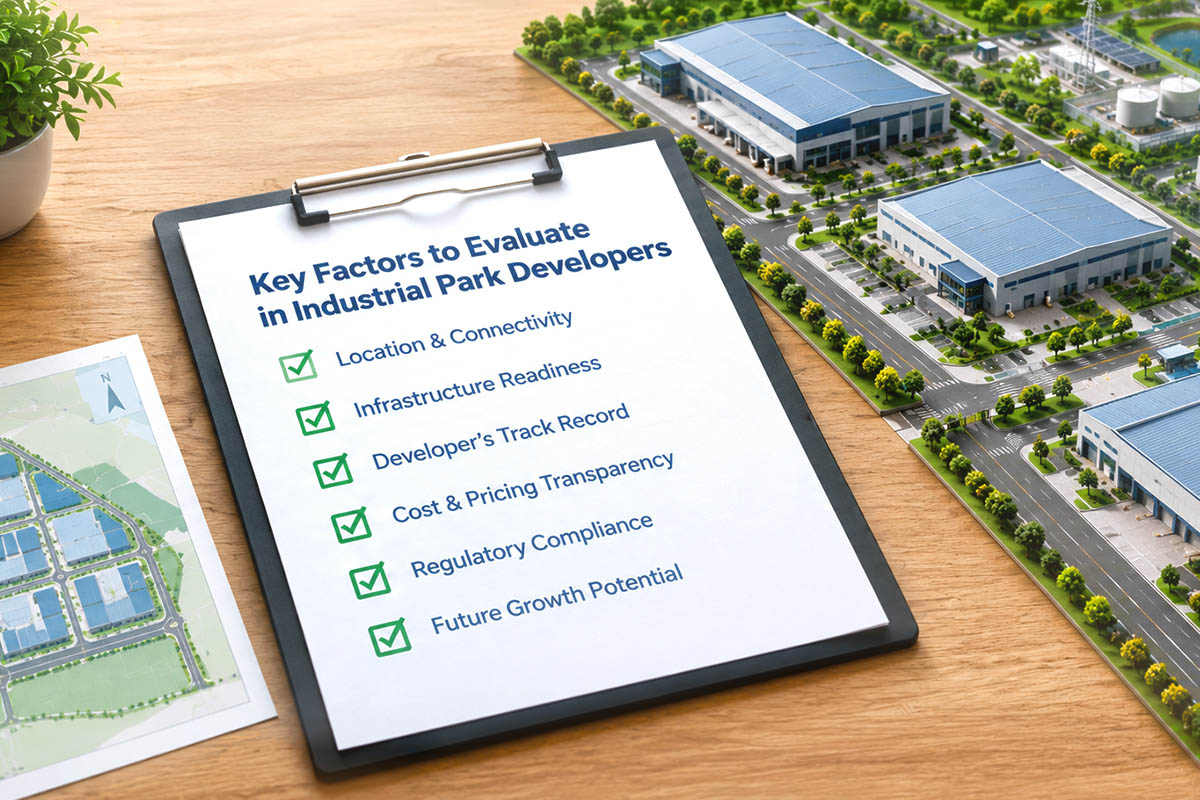
Choosing an industrial park is about more than finding available land at the right price. For manufacturers, logistics companies, warehouses, and other industrial businesses, the right location can influence everything from transportation and utility access to workforce availability and future expansion. That makes the choice of industrial park developers in India an important business decision. A developer does more than develop plots. The planning of roads, utilities, security, connectivity, common facilities, and the surrounding industrial ecosystem can directly affect how efficiently a business can establish and operate its facility.
So, before committing to an industrial park, what should businesses actually evaluate?
Your business is growing. Is your industrial space ready?
Explore Spaces Built for Growth
- Evaluate the Developer’s Track Record
The first step is to look beyond the current project and understand the developer’s experience. An industrial park is a long-term investment. A developer’s completed projects can provide useful insight into its ability to plan infrastructure, execute large developments, and create environments that support industrial operations.
Businesses should examine:
- Completed industrial and logistics projects
- Years of experience in industrial development
- Scale of projects delivered
- Types of industries served
- Existing businesses operating within its developments
- Infrastructure provided across completed projects
- Plans for future development
Mascot Infra, for example, has been developing industrial and logistics spaces since 1999. The company states that it has delivered 47 million sq. ft. of facilities, with another 25 million sq. ft. in its pipeline, across locations including Ahmedabad, Surat and Halol. The objective isn’t simply to choose the developer with the largest numbers. It is to determine whether the developer has experience relevant to your business’s scale, industry, and operational requirements.
- Look Beyond Location: Evaluate Connectivity
“Good location” means different things for different businesses. A manufacturing company may prioritise access to suppliers and highways. A logistics company may need efficient routes to markets and ports. A warehouse operator may place greater emphasis on distribution networks and urban accessibility.
Before choosing an industrial park, evaluate its proximity to:
- National and state highways
- Industrial corridors
- Ports
- Rail networks
- Airports
- Major cities
- Suppliers and ancillary businesses
- Workforce catchments
For example, Mascot Industrial & Logistics Park in Sanand is located at Kunvar Village, adjacent to Sanand GIDC, with access from the GIDC 16-metre road and connectivity to NH-47. The development is also positioned close to Ahmedabad and major industrial and logistics routes.
The right industrial location can change how your business moves.
Find Your Ideal Industrial Ecosystem
- Find Out What Infrastructure Is Actually Included
Not every industrial park offers the same level of infrastructure. Some developments may primarily provide industrial land, while others integrate roads, utilities, security, waste management, and supporting facilities into the overall development. Before choosing an industrial park in India, ask what is already provided and what the business will have to develop independently.
Important considerations include:
- Internal road network
- Power infrastructure
- Water supply and treatment
- Sewage and wastewater management
- Drainage
- Telecom connectivity
- Security
- Emergency access
- Weighbridges
- Common facilities
Mascot’s Sanand development lists internal roads, high-speed telecom connectivity, security measures, water treatment facilities, a weighbridge, emergency entry and exits, power supply, and a common sewage treatment plant among its infrastructure. This distinction matters because the cost and complexity of setting up an industrial facility can extend well beyond the purchase or lease of land.
- Assess Utility Capacity, Not Just Availability
Saying that an industrial park has electricity or water is not enough.
Businesses should understand whether the available infrastructure can support their actual operating requirements.
For example:
- Power: Can the electrical infrastructure support the planned machinery and production load?
- Water: Is the supply sufficient for manufacturing, sanitation, and other operational needs?
- Wastewater: What systems are available for sewage and wastewater management?
- Telecommunications: Can the location support the connectivity required for business systems, communication, and digital operations?
- Drainage: Is the site’s drainage infrastructure designed to manage heavy rainfall and surface water?
These questions become particularly important for manufacturing facilities, warehouses, process industries and businesses with high utility consumption.
Before you choose your next industrial location, see what you’re missing.
Discover Mascot’s Industrial Parks
- Examine Internal Roads and Heavy-Vehicle Movement
Highway connectivity is important, but businesses should not overlook what happens inside the industrial park. Factories and logistics facilities may regularly receive trailers, containers, raw-material vehicles, and finished-goods trucks.
Therefore, evaluate:
- Internal road widths
- Turning radius
- Entry and exit points
- Traffic circulation
- Loading and unloading access
- Emergency vehicle access
- Separation of different traffic movements
Mascot Industrial City in Vitthalapur, for instance, has internal roads ranging from 18 to 30 metres and four dedicated entry and exit points. Its infrastructure has been planned to support heavy industrial movement and long-term scalability. These details may seem secondary during a site visit, but they can have a direct impact on everyday logistics once operations begin.
- Consider Workforce Infrastructure
Industrial development is ultimately powered by people. Manufacturing and logistics businesses require operators, technicians, supervisors, drivers, support teams, and other employees. Consequently, workforce accessibility should form part of the location evaluation.
Consider:
- Availability of workers in nearby areas
- Access to surrounding cities and towns
- Employee transportation
- Accommodation
- Food facilities
- Medical support
- Training facilities
For example, Mascot’s Sanand industrial development includes a medical centre, dormitory facilities, canteen facilities, and training/seminar rooms alongside its industrial infrastructure. These facilities don’t replace the need for businesses to assess their own workforce requirements, but they demonstrate why an industrial park should be evaluated as an operating ecosystem, rather than simply as a plot of land.
Don’t let your next expansion be limited by your location.
Plan Your Next Industrial Move
- Check Whether the Development Can Support Future Expansion
Industrial requirements rarely remain static. A company may begin with one manufacturing unit and later need additional production space, warehousing, assembly capacity, or distribution infrastructure.
Before selecting an industrial park, ask:
- Is additional land available?
- Can the development accommodate larger facilities?
- Is infrastructure designed for future demand?
- Can operations expand without changing locations?
- Is the surrounding industrial ecosystem likely to support future growth?
This is particularly relevant when comparing industrial infrastructure developers in India. Mascot Industrial City at Vitthalapur spans 385 acres and has been planned as a large-scale industrial destination with wide internal roads, multiple entry and exit points, utility infrastructure, and provisions intended to support long-term scalability. Planning for expansion at the beginning can help businesses avoid treating relocation as their only growth strategy later.
- Evaluate the Surrounding Industrial Ecosystem
A business does not operate in isolation. Being located near suppliers, manufacturers, logistics providers, and other industrial businesses can create practical advantages for procurement, transportation, and vendor access. This is one reason established industrial clusters can be attractive to businesses. Mascot’s Sanand development is adjacent to Sanand GIDC and surrounded by established industrial activity. The project identifies proximity to major industrial facilities and Ahmedabad as part of its location advantages. Similarly, Mascot Industrial City in Vitthalapur is positioned within a broader industrial hub, with the project highlighting proximity to major automotive facilities and more than 250 businesses in the surrounding area.
When evaluating industrial parks in Gujarat, businesses should therefore look at the surrounding ecosystem, not only the boundaries of the individual project.
Looking for the right place to build your next facility?
Explore Mascot’s Industrial Parks
- Verify Documentation and Development Details
Infrastructure is only one part of due diligence. Before committing to an industrial property, businesses should independently verify the documentation and applicable requirements for the specific property and intended use.
This can include:
- Land ownership and title
- Applicable zoning and land-use permissions
- Development approvals
- Infrastructure commitments
- Utility arrangements
- Possession timelines
- Applicable charges
- Project documentation
- Terms and conditions of the transaction
The exact requirements will vary depending on the location, project structure, and nature of the proposed industrial activity. A credible developer should be able to provide clear project information and documentation for the buyer’s due diligence process.
- Compare Total Operating Costs, Not Just Land Prices
A lower land price does not automatically make an industrial location more economical. Businesses should consider the broader cost of operating from the site.
A useful comparison includes: Land + infrastructure + construction + utilities + logistics + workforce + maintenance + future expansion
For example, a location that appears cheaper initially may require significant additional investment in infrastructure or create higher transportation costs over time. Another development may provide more integrated infrastructure but have a different upfront cost structure.
Your next industrial opportunity could be closer than you think.
Explore Industrial Parks in Gujarat
- Assess Security, Safety and Emergency Access
Industrial facilities may handle heavy machinery, vehicles, inventory, raw materials and continuous movement. Security and emergency planning should therefore be part of the initial site evaluation.
Businesses should examine:
- Controlled entry and exit
- Security systems
- Internal lighting
- Emergency access
- Vehicle movement
- Common-area management
- Fire and safety provisions applicable to the development and individual facility
These factors become especially relevant for businesses operating at scale or across extended working hours.
Industrial Park Developer Evaluation Checklist
Before finalising an industrial park, businesses can use this checklist:
Evaluation Factor | What to Check |
Developer experience | Completed projects, years of experience and relevant industrial expertise |
Location | Highways, ports, railways, cities, suppliers and workforce |
Infrastructure | Roads, power, water, drainage, sewage and telecom |
Utility capacity | Whether infrastructure can support present and future demand |
Vehicle movement | Road widths, turning space, loading access and entry/exit points |
Workforce | Accessibility, accommodation and supporting facilities |
Expansion | Availability of additional space and scalable infrastructure |
Industrial ecosystem | Nearby manufacturers, suppliers and logistics businesses |
Documentation | Land, approvals, utilities and transaction details |
Total cost | Land, construction, infrastructure, logistics and operating expenses |
Safety & security | Security systems, emergency access and applicable safety provisions |
Frequently Asked Questions
1. What should businesses look for in industrial park developers in India?
Businesses should evaluate the developer’s track record, project infrastructure, location, connectivity, utility capacity, workforce facilities, expansion potential, documentation, safety provisions, and the surrounding industrial ecosystem.
2. Why is the developer’s experience important when choosing an industrial park?
An experienced developer can demonstrate its capabilities through previously delivered projects, infrastructure execution, and established industrial developments. Businesses should review relevant completed projects rather than relying only on marketing claims.
3. What infrastructure should an industrial park provide?
Depending on the project, businesses may look for internal roads, power, water, drainage, sewage management, telecom connectivity, security, emergency access, and common facilities.
4. How important is connectivity for an industrial park?
Connectivity can influence the movement of raw materials, finished goods, employees, and suppliers. Businesses should evaluate access to highways, industrial corridors, ports, railways and nearby cities based on their specific logistics requirements.
5. Should businesses consider future expansion when choosing industrial land?
Yes. Businesses should assess whether additional land, infrastructure capacity and suitable facilities will be available if production, warehousing or workforce requirements increase.
Choosing an Industrial Park Is Choosing an Operating Environment
The right industrial park should do more than provide a plot. It should give a business an environment where materials can move efficiently, employees can access the workplace, utilities can support operations, infrastructure can accommodate growth, and the surrounding ecosystem can support long-term business activity. That is why evaluating industrial park developers in India requires looking at more than brochures and land prices. Developer experience, connectivity, infrastructure, utilities, workforce support, scalability, documentation, and total operating costs should all form part of the decision-making process.
Mascot Infra’s industrial portfolio includes developments in Kadi, Kheda, Sanand, Surat and Vitthalapur, with projects designed around industrial and logistics requirements. Its Kadi industrial park, for example, spans 85 acres and is positioned on the Kadi-Vitthalapur corridor, while its Sanand development covers 50 acres adjacent to Sanand GIDC.
Planning your next industrial facility?